The Drop: A Snowfall Saga Brings Snowfall Into the Rap Era
Written by QueFourFive on September 9, 2026
 The Drop: A Snowfall Saga Brings Snowfall Into the Rap Era
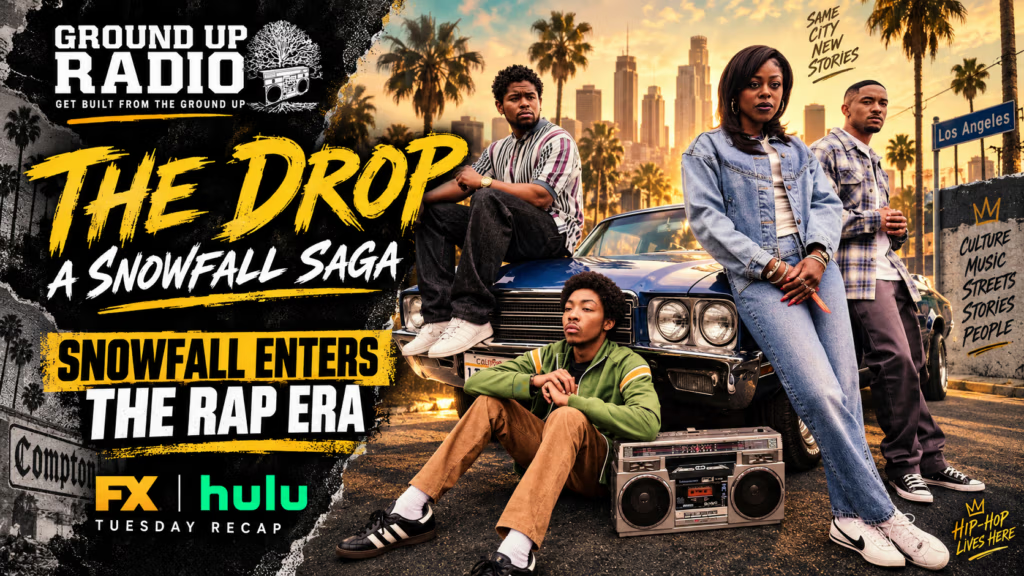
The world of Snowfall is moving into a new decade—and a new hustle. FX’s The Drop: A Snowfall Saga brings Wanda Bell and Leon Simmons back to 1990s Los Angeles, where the damage left by the crack epidemic is colliding with another force powerful enough to reshape the city and the culture: West Coast rap.
The new series premiered September 8 and is now streaming on Hulu, with new episodes scheduled weekly. For longtime Snowfall viewers, the story offers a continuation of two familiar characters. For hip-hop fans, the bigger draw may be the era itself. The Drop: A Snowfall Saga shifts the center of gravity from the drug economy that defined much of the original series toward the music, ambition, street politics, and creative explosion that would help make Los Angeles one of the most important cities in rap history.
The Drop: A Snowfall Saga Moves the Story Into the Rap Era
Snowfall was built around the human cost of the crack epidemic and the systems surrounding it. The Drop picks up after that devastation, as a new generation begins looking for another way forward. Music is no longer just background. It becomes opportunity, identity, business and, potentially, escape.
That shift gives the series a natural connection to hip-hop history. By the early 1990s, West Coast rap was moving from regional force to national cultural power. Los Angeles was producing new sounds, new independent business models, and new stars while many of the same neighborhoods were still dealing with the consequences of violence, policing, poverty, and the drug trade.
That is the tension at the heart of The Drop: A Snowfall Saga: what happens when creative ambition rises out of a place still carrying the weight of the previous era?
Wanda and Leon Return With Different Missions
Gail Bean returns as Wanda Bell, while Isaiah John reprises the role of Leon Simmons. Their lives remain connected, but their paths are increasingly shaped by different ideas about what rebuilding should look like.
Wanda sees possibility in the emerging rap scene. She believes the music can become more than entertainment—it can become a vehicle for transformation. Her efforts pull her toward young artists, family members, and the growing music business, including the dangerous overlap between street credibility and industry opportunity.
Leon, meanwhile, is trying to move further away from the life that shaped him. His focus on accountability and community puts him on a different track from Wanda, creating a conflict that feels bigger than a relationship issue. The two characters represent competing questions that have followed hip-hop throughout its history: Can the culture create a path out, and what does it cost when the same forces people are trying to escape become part of the business?
A New Cast Steps Into 1990s Los Angeles
The series expands beyond Wanda and Leon with a new group of characters tied to music, family, and the streets. Asante Blackk plays Lamar Kinsey, a gifted young musician whose talent brings both possibility and vulnerability. Peyton Alex Smith plays his older brother James Kinsey, while Simmie “Buddy” Sims III appears as local rapper Artillery.
Brandon Mychal Smith also joins the story as Darryl “DG” Grant, a former drug dealer turned label owner. That character may be one of the clearest examples of the transition the series is exploring: the movement of money, influence, and hustle from the street economy into the emerging rap business.
Rather than treating hip-hop as a finished industry, The Drop is positioned in a period when the rules were still being written. That gives the show room to explore not only artists and songs, but ownership, exploitation, independent ambition, neighborhood loyalty, and who gets to profit when a local sound becomes national culture.
Why The Drop Matters to Hip-Hop Culture
For Ground Up Radio, this is where the series becomes especially interesting. Hip-hop history is often told after the fact, once the legends are established and the classic albums have already been canonized. The Drop: A Snowfall Saga is built around the unstable period before that certainty—when artists, hustlers, families, labels and communities were all trying to understand what rap could become.
That matters because the rise of West Coast rap was not simply a music story. It was a media story, a business story, and a story about Black communities creating value from experiences that mainstream America often misunderstood or ignored. The music became a way to document neighborhoods, challenge narratives and create independent economic power—even as the industry developed new ways to commercialize that authenticity.
If the series stays committed to that complexity, it has the opportunity to do more than extend the Snowfall universe. It can use television to explore a major turning point in hip-hop history without separating the music from the social conditions that produced it.
Where to Watch The Drop: A Snowfall Saga
The Drop: A Snowfall Saga premiered on September 8, 2026. The series airs on FX and streams the same day on Hulu, with Hulu on Disney+ available to eligible bundle subscribers. New episodes are scheduled to roll out weekly through October 27.
The show is created by Malcolm Spellman and produced by FX Productions. The core cast includes Gail Bean, Isaiah John, Asante Blackk, Peyton Alex Smith, Simmie “Buddy” Sims III, Brandon Mychal Smith, Nicki Micheaux, and Mykelti Williamson.
Ground Up Radio Take
Snowfall documented what happened when an economy of destruction took hold. The Drop begins by asking what happens when a culture tries to build something from what is left behind.
That is a strong foundation for a hip-hop story. Wanda and Leon give the audience an emotional bridge from the original series, but the rise of West Coast rap gives this new chapter its own reason to exist. The most important question now is whether The Drop: A Snowfall Saga can capture the music industry, the neighborhoods, and the creative energy of early-’90s Los Angeles with the same level of detail that made Snowfall connect.
Are you watching? Tap in with Ground Up Radio and tell us whether The Drop feels like a worthy continuation of the Snowfall story—and which part of the West Coast rap era you want to see the series explore next.