Common’s SoundExchange Music Fairness Award: Why It Matters
Written by QueFourFive on October 1, 2026
Common’s SoundExchange Music Fairness Award: Why It Matters
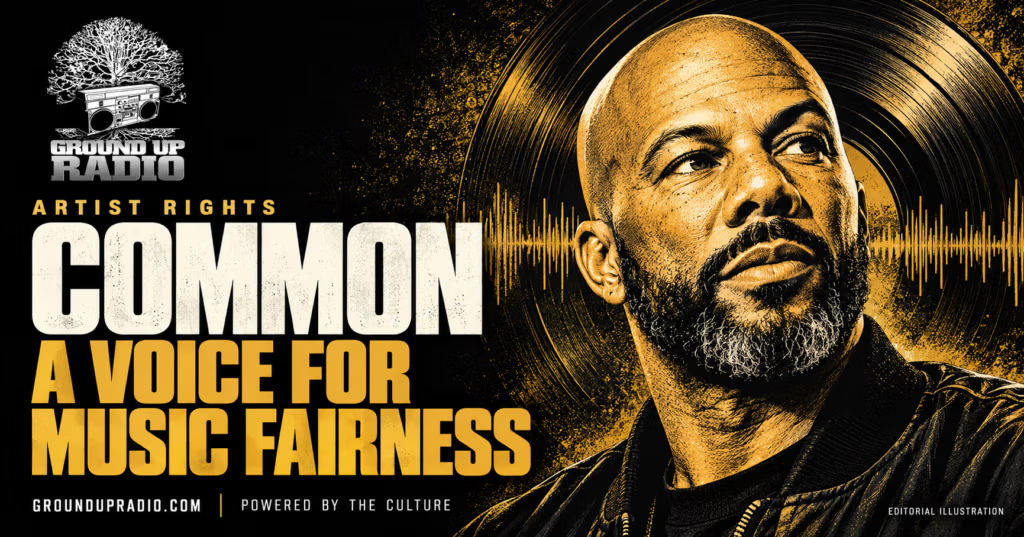
Common and the conversation around artists’ rights. AI-generated editorial illustration for Ground Up Radio.
Common’s SoundExchange Music Fairness Award put a spotlight on a question that reaches far beyond one artist: how should performers get paid when radio stations use their recordings?
SoundExchange announced the honor on December 21, 2023, recognizing Common’s advocacy for the American Music Fairness Act. That date matters. This is a look back at the award and its significance, with a separate 2026 development bringing his work back into focus.
For independent hip-hop artists, the story offers a useful starting point for understanding the business behind radio exposure.
Why Common received the SoundExchange Music Fairness Award
According to SoundExchange’s original announcement, Michael Huppe presented the award during the organization’s 20th anniversary celebration at The Anthem in Washington, D.C.
The recognition highlighted Common’s support for paying performers when terrestrial radio broadcasts their music. Previous recipients included Gloria Estefan and Dionne Warwick.
The award connected Common’s public platform to a specific industry issue: compensation for the people whose recorded performances help power radio programming.
The royalty distinction behind the debate
A song’s composition and its recorded performance involve different rights. That distinction helps explain why an artist can hear a record on the radio without every contributor receiving the same kind of payment.
SoundExchange’s FAQ distinguishes its work for featured performers and recording owners from the songwriting royalties handled by ASCAP, BMI and SESAC.
| Royalty category | What it covers | Relevant collection route |
|---|---|---|
| Composition performance royalties | The underlying music and lyrics | Performing rights organizations such as ASCAP, BMI and SESAC |
| Sound recording digital performance royalties | The recorded performance on eligible non-interactive digital services | SoundExchange under the U.S. statutory license |
SoundExchange says traditional U.S. over-the-air broadcasts do not generate the sound recording performance royalties it seeks for artists and labels. That does not mean radio pays no music royalties: the composition is a separate part of the picture.
For artists who both write and perform, understanding those roles can make royalty statements easier to interpret.
What the American Music Fairness Act proposes
The introduced text of H.R. 861, the American Music Fairness Act of 2025, would extend the sound recording performance right to terrestrial audio broadcasts. The bill was introduced on January 31, 2025.
Its provisions include reduced annual fees for qualifying smaller broadcasters, protections for songwriting royalties, and consideration of radio’s promotional value when setting rates. These are provisions in a legislative proposal; an award announcement is not evidence that new royalty requirements have taken effect.
There is disagreement over the approach. SoundExchange supports the measure as a way to compensate creators for broadcast use of their work. The National Association of Broadcasters opposes it, arguing against additional fees on local radio and pointing to stations’ community services.
For Ground Up Radio’s audience, both the creator’s income and the broadcaster’s ability to serve listeners deserve a clear explanation.
A separate Common honor in September 2026
There is also a newer story. SAG-AFTRA and SoundExchange presented Common with the 2026 Artist Impact Award on September 24, 2026, at The Luckman Club at Soho House West Hollywood.
That award recognized work across music, film, television and media. It is distinct from the Music Fairness Award announced in 2023.
The newer recognition broadens the conversation around Common’s career. His earlier honor focused on advocacy for performers’ compensation; the 2026 award celebrated the reach of his creative work across disciplines.
What independent artists can do now
Artists can use this story as a prompt to review their own royalty setup. SoundExchange’s creator resources explain how registered creators can claim recordings, manage their catalogs and review payments.
- Check your registration. SoundExchange offers free registration for eligible creators and recording owners.
- Review your recordings. Confirm that the catalog you claim reflects your actual performances and ownership.
- Keep account details current. Check your contact, tax and payment information.
- Know which role you hold. Performing on a record and owning its master are separate roles; an independent artist may hold both.
At Ground Up Radio, our takeaway is practical: build business knowledge alongside your audience. Learning which rights you hold helps you ask better questions about how your music earns income.
TAP IN: What part of music royalties do you wish someone had explained before your first release? Share your thoughts in the comments, explore more Ground Up Radio coverage, and listen to Ground Up Radio.